Mark Frankland is a remarkable author.  One of the few to dare to use a work of fiction to tackle head-on the subject of The Troubles of Northern Ireland, he has penned a comprehensive, warts-and-all and even-handed account of that long, internecine conflict.

In writing Terrible Beauty, he might well have incurred the wrath of either side of the sectarian divide – or, indeed, of both sides.  But Mark Frankland is also a remarkable storyteller, because he pulls off the impossible.  In a narrative spanning more than three decades and interspersed with actual events and real people, he weaves together with fairness and precision, and always with confidence, the parallel life stories of the two central characters.  Through their eyes, we are privy to utterly contrasting visions of the treacherous, vicious world that is Ulster.  We meet and understand the motives of the men of violence in both camps.  And we learn time and again of the arrogant, indifferent and often cowardly role in the conflict of successive British Governments.

In addition to being a damn good thriller in its own right that is nail-biting to the very end, Terrible Beauty is to be recommended as an unbiased and reliable history of The Troubles.  The book has the ring of authenticity about it.  When I read the author’s end-notes, I wasn’t surprised to discover the scale of his research in preparing for the novel.  Nor was I surprised to learn that the two main protagonists – the Republican Sean O’Neill and the Loyalist Davie Stanton – are based on real people, real players in the Ulster cauldron – “two of the most impressive men I have ever met”, says Frankland.

But have you noticed what I did there?  Unconsciously, without thought, I placed the Republican first, the Loyalist second; the Catholic before the Protestant.  The book doesn’t do that – it is balanced throughout – but I did.  I did it on reflex to reflect my sympathies, my loyalties.  You see, in the same decade that the fictional Davie Stanton’s grandfather took up arms with Carson’s Ulster Volunteer Force, my own grandfather on my mother’s side took up opposing arms in the south of Ireland, joining the Irish Republican Army in 1918, when he was barely eighteen, and going on to serve in the Irish War of Independence under Michael Collins.  That War was a direct consequence of the Easter Rising of 1916, when a group of poets and dreamers and old men took over the General Post Office in Dublin and proclaimed an Ireland free from British rule.  “A terrible beauty is born” wrote William Butler Yeats shortly after the foolhardy rising was brutally quelled, the novel’s title being borrowed from that line of his.

The story of the birth of the “terrible beauty” has stayed with me all my life; you could say I was weaned on it.  I’ve stood and wept on the spot in Kilmainham Gaol in Dublin where they executed those poets and dreamers and old men – “MacDonagh and MacBride/And Connolly and Pearse” and ould Tom Clarke and many others.  I know in my heart that I’ll never forgive the British Government for those executions, for their duplicity beforehand in allowing and abetting Carson’s “army”, and for their cowardice in capitulating to the bullies and bigots of Ulster.  I know in my heart that I will always detest the Orangeism that is the way of life of those bigots and bullies.  And I know in my heart that while brave authors like Mark Frankland will continue even-handedly to analyse and explain the Ulster conflict in novels like Terrible Beauty, they will not be able to shift the legacy of the British Government’s actions, the terrible legacy of hate.  Not until the institution of that hate, the Orange Order, is dismantled and outlawed throughout the British Isles.  And it would take a very courageous Government indeed to do that.

I’ll close my review of this excellent book with an anecdote.  I worked closely for many years with two Ulstermen.  Both were intelligent and articulate, and both had moved from Belfast to Scotland to escape The Troubles at home.  Whenever we all got together for a drink, invariably this pair would gleefully swap stories about the slow-witted Taigs they had known back home.  Invariably, too, they would speak contemptuously of the Republic as if it were some poor, illiterate neighbour, decrying its littered streets, its pot-holed roads and its inability to organise a wake let alone the country’s economy – and this in spite of the fact that their homeland had been reduced to an economic desert.  On one occasion, another colleague, a Geordie with little or no knowledge of Ireland’s history, declared his interest in seeing Neil Jordan’s recently released movie, Michael Collins.  One of the Ulstermen, who possessed a PhD from Queen’s University of Belfast, spluttered over his pint.  “Michael Collins?  Michael Collins?” he spat out.  “He was nothing but a Fenian thug.”  A peace agreement in Northern Ireland was almost tangible at the time, but that didn’t matter.  There was no thought given.  No conciliation.  No surrender.  The legacy of hate continued unabated.

Go to Amazon today and download the Kindle version of Terrible Beauty or order a copy of the paperback.
 
 
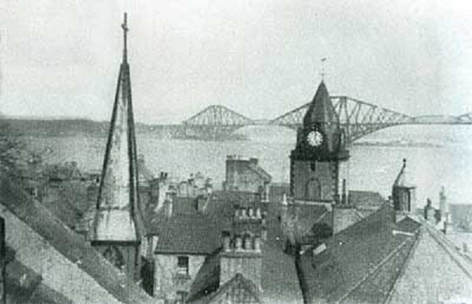
Having begun my life in the ancient Burgh of South Queensferry on the southern shore of the estuary of the River Forth, I grew up with the iconic Forth Railway Bridge practically on my doorstep.  I’ve always been enthralled by the majesty of that old bridge and by the magical beauty of the landscape it straddles and dominates.  I’ve been away from the place for a while, but I can still picture the often mirror-like surface of the estuary; that archipelago of tiny islands strewn down the centre of the estuary, resembling a giant’s stepping-stones; and those frequent heart-stopping sunsets, when the crimson glow of the bridge is reflected in the estuary so that the shimmering water looks as if it has caught fire.

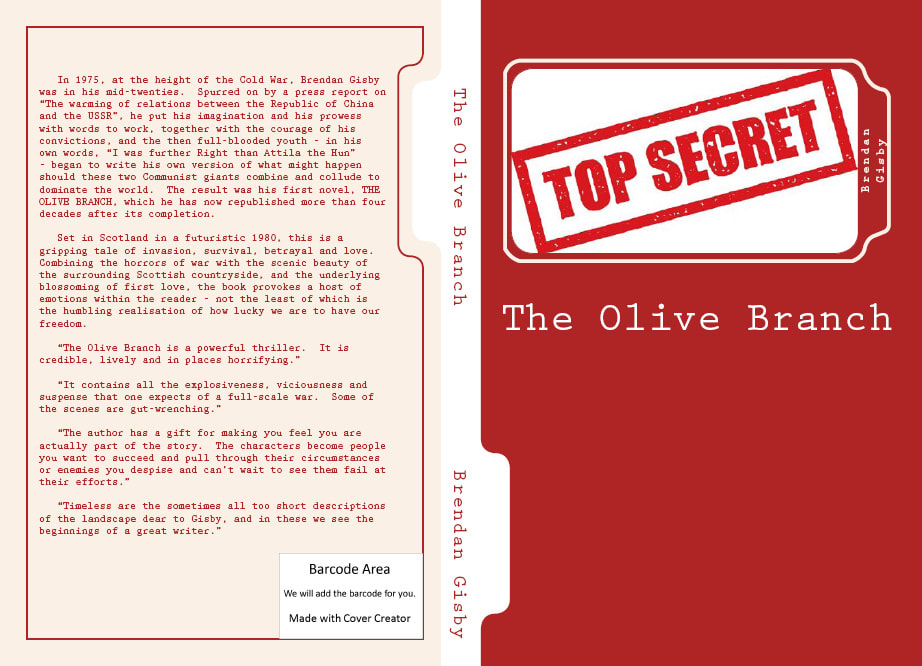
Little wonder, therefore, that the landscape features so much in my writing.  It’s the setting for my first novel, a Cold War thriller entitled The Olive Branch, which I wrote nearly forty years ago.  In it, the poor bridge is destroyed early on in a missile attack by invading Sino-Soviet forces, but that’s the Cold War for you!  I recently published another novel about the writing of that first novel.  Confusing, isn’t it?  The new novel is called The Preservation of “The Olive Branch”.  It has this week been added to the Awesome Indies listing of quality Indie published books, so it might be worth a look.

I’ve also published a couple of collections of short stories about growing up in South Queensferry – the Ferry, as we locals know it.  Ferry Tales is set in the austere times of the 1950’s and early 1960’s.  And Lost Between the Bridges continues the stories from the Swinging Sixties into the dark winter of 1970.  Between those two collections, I penned The Bookie’s Runner, an account of the short and tragic life of my father, a true Ferry man.
Then, of course, there’s The Island of Whispers.  It’s an adventure story, a cross between Watership Down and Animal Farm, set on one of those giant’s stepping-stones, the one tucked under the Forth Bridge by the name of Inchgarvie.  Much of the action takes place in the run-up to and during the bridge’s centenary celebrations.  Here’s an extract from the book, a wee homage to the birthday girl:
“For a hundred years, the Forth Railway Bridge had straddled the banks of the estuary, a permanent bond between the ancient burgh of Queensferry to the south and its identically named neighbour across the river.  A century of sunrises had woken the giant, beginning afresh its sovereignty of the landscape.  Across the decades, it had looked down imperiously on the ebbs and flows of human development: unflinching in 1939 when the Luftwaffe came so very close to success; indifferent to the demise of the sturdy steam locomotives which had crawled, chugging and panting, through its massive belly; still defiant in 1964 when a rival road bridge sprang up on its horizon: a sleek, modern pretender to its vast kingdom.  Now, in 1990, its centennial year, the old monarch remained aloof from the rush of activity along its mighty arches.”

Picture
All of which brings me to announce the publication this week of my latest novel, a fiction called The Burrymen War.  As the title implies, the story concerns another world-renowned Ferry icon, the ancient tradition of the Burryman ceremony.  Dealing with issues such as bigotry, violence and murder, it’s a gritty novel which casts the town in a darker light.  Having said that, it’s chockfull of Ferry characters and their unique brand of humour.  Go to Amazon, sneak a preview of the paperback or the Kindle edition and see what you think.

Whatever you do about The Burrymen War, I can also announce that it’s probably the last time I write about the Ferry – at least for the foreseeable future.  Having penned so much about the town, the old bridge and the landscape of my childhood, I’m sort of all Ferry-ed out now.  There are other places and events and people to write about, other scores to settle, other wrongs to right.  So watch this space for the next instalment!


No, it’s not a clarion call to the people of Scotland to vote YES in the forthcoming Independence Referendum.  It’s simply a follow-up to my earlier post McPublish And Be Damned!, in which I declared my New Year’s Resolution to become a truly independent author and publisher.

I’m delighted in this post to report job done.  My two remaining books with publishers, The Bookie’s Runner and The Preservation of “The Olive Branch”, have now been given a makeover and re-published under the McStorytellers label.

I’ve no doubt that under its new stewardship The Bookie’s Runner will continue to be popular among readers.  The true story of a downtrodden man, which most people seem to connect with immediately, it has been called “a modern masterpiece” and has been compared with classics like Bonjour tristesse.

Sadly, I don’t think The Preservation of “The Olive Branch” will ever be as popular or as widely acclaimed.  As the author Cally Phillips said in a recent review of the book, “It does not just defy genre, it almost defies definition.”  And therein lies its lack of appeal.  Because it’s different, it’s a challenge to read.  Few want to take up the challenge, yet those who do invariably feel rewarded by the experience – “Gobsmacked!” declared one highly respected reviewer.

Actually, though, I’m no longer overly bothered about the book’s popularity.  In the spirit of a true “indie”, what matters to me now is that it has been formatted, covered and described my way.  I can decide when and how – and even if – to promote it.  I’ll be the first to know if someone has ordered the paperback or if a copy of the Kindle version has been downloaded.  And I’ll know quickly.  I’ll be able to experience that tiny ray of sunshine piercing through the dark Amazon clouds.  I won’t be kept waiting any more to find out about the sale six months or even a year later, by which time that little golden moment has long gone.

That’s what I love about being “indie”.  It means being in complete control – of production, of promotion, of sales.  And that’s why independence will always receive a YES vote from me!
 
 
Okay, my hands are up.  You’ve caught me.  It’s a fair cop, guv.  I admit it.  I’ve been a Fairtrade shunner.

You see, up until now I’ve been under the impression that Fairtrade was one of those mantras intoned by the green-welly-wearing, Barbour-jacket-sporting, African-trinket-shopping brigade.  You know the brigade I mean: the comfortable, well-fed, middle-class pseudo-hippy types who invented PC.  I actually thought Fairtrade was PC.  And I don’t do PC.

Then I read Fair Trade Fiction, a little collection of short stories by author and playwright Cally Phillips, and I’m now an avid supporter of Fairtrade.  I learned more from the stories than I would ever have from any amount of haughty pronouncements by the aforementioned brigade.  I learned about the modern-day exploitation of poor workers across the globe; not just the nature of the exploitation, but the sheer scale of it and its impact on so many aspects of my life – the tea and coffee I drink, the fruit I eat, the sugar and chocolate I (shouldn’t) ingest, even the clothes I wear.  I learned about the concept of Fairtrade and how it can operate to combat that exploitation.  And I learned how to look for the Fairtrade label.  I learned all of that – and I became a Fairtrade convert into the bargain – in a very short space of time.

There’s a big lesson here for the PC crowd.  Instead of preaching, do what Cally Phillips has accomplished so successfully with this collection.  Write your message into short stories.  Populate your stories with everyday, believable characters.  Add a large dollop of humour and a sprinkling of make-believe.  And I guarantee you’ll have people converting to your message faster than your green wellyboots can carry you!

There’s a second volume of Fair Trade Fiction due to be published in time for World Fair Trade Day 2013; watch out for it.  Meantime, go to this link on Amazon to download the first volume.

This review has been written and posted by a member of the Reading Between the Lines Review Collective.
 
 
In my previous post, So Who Is Che Guevara’s Lovechild?, I explained that my New Year’s Resolution #1 is to do more to publicize the reviews I write of other authors’ work.  With the end of January fast approaching, I thought it was about time I also explained my New Year’s Resolution #2.  Which is all about publishing.  Or self-publishing, to be more precise.

I entered the murky world of publishing rather late in the day.  I was almost sixty when my first book, The Island of Whispers, was published in 2009. Since then, I’ve had another four books published by two publishers.  Most of the five books have achieved a fair degree of success, The Bookie’s Runner, in particular, having made regular appearances on Amazon’s bestseller lists.

Last year, along with my cousin Phil Gisby, I co-wrote a little family biography called The Five Sons of Charlie Gisby, which I proceeded to self-publish using Amazon’s CreateSpace for the paperback edition and Kindle Direct Publishing for the Kindle version.  The book proved to be immensely popular not only within the worldwide Gisby clan, but also among Kindle readers throughout the UK, and for many months could be found in the Top 100 Historical Biographies on Amazon.

Using the same free Amazon resources, I went on to publish another family biography, a couple of anthologies of stories from McStorytellers, the burgeoning Scots-connected short story website I founded in 2010, and several short story collections of my own.  Under the by then well-established McStorytellers label, I also began to publish work on behalf of regular contributors to the site.  Including those anthologies and my own collections, there are now more than a dozen McStorytellers publications.

Having learned the few technical ropes early on, I’ve found the whole self-publishing malarkey a very easy process.  It is also tremendously satisfying.  No queuing for months when you want something published.  No frustrating communications with publishers; they’re all nice people, but their communication skills are piss-poor.  Instant access to information about your books.  And you’re in charge, in total control of the whole process.

Which brings me at last to my New Year’s Resolution #2.  It is to extricate my books from the hands of those publishers and self-publish them under the McStorytellers label.  I’ve achieved that already with two of the books.  That first published novel of mine, The Island of Whispers, and my first collection of short stories, Ferry Tales, were both given a fresh look and re-published earlier this month.  The rest will follow in a matter of weeks.
So that’s one resolution I do intend to keep.  Very soon now I’ll become a truly independent author and publisher.  I’m looking forward to joining the growing ranks of those established and respected authors who have also had the courage to sever ties with their publishers and go completely “indie”.  We’ll all be bravehearts together in the publishing revolution!
 
 
Although I’ve been writing reviews of other authors’ books for some time now, I know that I’ve not put much effort into publicizing the reviews.  My New Year’s Resolution #1 is to remedy that failing by posting the reviews here on The 4B’s Blog.

This is the first such post.  It’s my review of a brilliant book called Another World is Possible.  Written by the equally brilliant author, playwright and Che Guevara devotee, Cally Phillips, the book, as you’ll gather from the following, is nothing less than a multi-layered enigma.

If you are one of those readers who simply devours fiction – you know the kind of fiction I mean: clichéd romances and thrillers, with stereotypical characters and pedestrian writing – then this book is NOT for you.  Another World is Possible is for those who want something different to read, something challenging, something authentic.  In short, it is a book for thinkers.

Those words “different”, “challenging” and “authentic” sum up the book.  It is constructed like a set of Russian dolls: there are puzzles within riddles within a conundrum.  The overarching conundrum is, of course, whether Roisin really is the lovechild of Che Guevara.  I’ll say no more about that, except to warn you thinkers that you’ll be kept guessing throughout.

You’ll also constantly ask yourself other questions.  Who is narrating the story?  How much of what they say is truthful?  Where does the reality of the story end and the fiction begin?  An awful lot is known publicly about the life and death of Che Guevara.  But did he really stop off at Dublin Airport in 1964 and Shannon Airport in 1965?  Is it possible that his words and actions during those stops altered so dramatically the course of the lives of characters in the book?

And there are as many, if not more, questions about the author.  We know, because Cally Phillips tells us in the introduction to the book, that her lifelong interest in Che is something of an “obsession” (her word).  Cally also tells us that the story is “personal” to some extent.  But to what extent?  The mother/daughter relationship between Mary and Roisin is so finely drawn you just know it must be based on reality.  And the squats in London in the Sixties are so accurately described you feel she must have experienced that life as a child.  The same goes for the London music scene in the Seventies.  Then suddenly you find yourself wondering, even though you know it can’t be possible, whether the author herself is the lovechild of Che Guevara.

See what I mean?  Questions upon questions; riddles everywhere.  It’s a challenging book, to say the least.  Not only is it cleverly conceived and constructed, it is also written in clear, unadorned prose.  A must for thinking readers everywhere.

If you fit that bill, go to these links on Amazon to download the Kindle version or to order up a paperback copy.

This review has been written and posted by a member of the Reading Between the Lines Review Collective.
 
 
After airing some of my early short stories here on Blazes Boylan’s Book Bazaar, I decided to take the plunge and publish the whole back catalogue.

The new collection is called Pud’s Legacy.  In addition to those old stories, it includes as a bonus feature my acclaimed long short story, The Hitchhiker.  Why?  Well, to paraphrase The Big Lebowski, that story really ties the collection together, man.

Anyway, click here for the full gen on it.  You may want to give it a punt.
 
 
...there was Tom & Jerry.  Read Animated Delights if you want my view of the world when I was in my twenties.

And my view of the world now, nearly four decades later?  Well, nothing much has changed...
 
 
...there were Milk Bars.  Here's a wee story about the Milk Bar in Shandwick Place, Edinburgh.  Called The Teashop, it was written nearly forty years ago.

Enjoy it with your tea or coffee.
 
 
Forget the snow.  Imagine Paris in the springtime – 1980’s style.

To transport you there, here’s a thirty year-old short story of mine.  Called The Room with a View, the story introduces a brand new sleuth.  She’s young and blonde and blue-eyed.  And she’s very clever.

Enjoy!